
Codehesion
Let’s talk
How we work · Field guide

A complete software team.Attached to your business when you need it.

Outside help usually arrives as developers and a project manager. That's it. Nobody checks that it's the right thing to build, nobody tests it properly, and nobody plans for the day it has to scale. With us you get the whole team behind every sprint: analysis, design, architecture, development, testing and releases. You pay for the hours you use, and they go wherever your product needs them that month.

This guide is what we'd tell you in a first meeting, written down.

A Codehesion pod of developers, designers and analysts in a planning session
02

1. The team you get

Every client gets an Innovation Pod: experienced specialists in every discipline a software product needs, already used to working together. It can run a project on its own, or work inside your team to add the skills and hands you're missing.

  1. 01

    Team lead and architect. Technical direction, architecture and the final word on quality.

  2. 02

    Project manager. Your one point of contact, who plans the work and keeps it moving.

  3. 03

    Business analyst. Turns what you need into clear requirements that can be tested.

  4. 04

    UX designer. Designs screens your users understand.

  5. 05

    QA engineer. Tests every change before you see it.

  6. 06

    DevOps engineer. Pipelines, cloud set-up and releases.

  7. 07

    Developers. Back-end, front-end and mobile.

You don't pay for people sitting idle. Your monthly hours go where the work needs them: more analysis in the first weeks, more development in the middle, more testing before a release. Analysis, QA, test automation and DevOps are part of every team, because they're what keeps software working long after launch.

If you're looking for a talent marketplace, this isn't it. If you're looking for a talent filter, that's us: only the top 3% of applicants make our team.

03

2. Inside your team, or on your behalf

Most of our clients already have developers, so we join their setup. Others hand us the whole project. Either way it's your code, and our standards come with it.

Working inside your teamWe take the project on for you
CodeYour repo and branches, your pull-request rulesStill your repo and your accounts; we push the code and run the branches
ToolsAzure DevOps, Jira, GitHub, GitLab: whatever you already useOur proven set-up, or yours if you prefer
ReviewsAI reviews every change first, then one of our engineers, then your reviewers approveAI reviews every change first, then a named engineer
StandardsYours, with what we've learnt across 100+ products blended inOurs, applied to your codebase
Existing codeWe read it before we change it, and add tests around what already worksThe same

A pod can start within 1–4 weeks of signing. Before the first sprint, we get access, read the code, meet your team and agree how we'll work together. A Discovery week for new work, or a code audit for existing code, usually comes first, so the first sprint starts with a plan.

3. A note for your developers

We know what it's like when an outside team arrives. Will they understand the system? Will they pull on a string and break something? Are they here to take over?

Here's how we work. We learn your codebase before we change it. We work through your reviews and follow your standards. We write code you'd be happy to own, with tests and documentation.

We also bring what we've seen across many industries and more than a hundred products: the practices that keep software easy to change as it grows. We pair with you and share all of it, including how we use AI.

Your knowledge of the business is what makes this work. We're here to add to it, take the pressure off your capacity, and enjoy building it together.

The Codehesion engineering team

04

4. How a sprint works

We work in two-week sprints. Whether we're inside your team or building the product for you, every sprint goes round the same loop and ends with working software you can see and approve.

  1. 01

    Plan. We agree the sprint's goals with you, from a backlog you can see.

  2. 02

    Build. Our developers build to that plan, with AI doing the routine work and the developers in charge.

  3. 03

    Review and test. Every change is reviewed before it merges. Automated tests and our coding standards run in the CI/CD pipeline on every change, and QA checks every ticket.

  4. 04

    You approve. You try it in a test environment and sign it off.

  5. 05

    Release. Through the CI/CD pipeline, automated and repeatable. Nothing goes live by hand.

Reviews and testing are part of every sprint, so you never pay a second time to have the work checked.

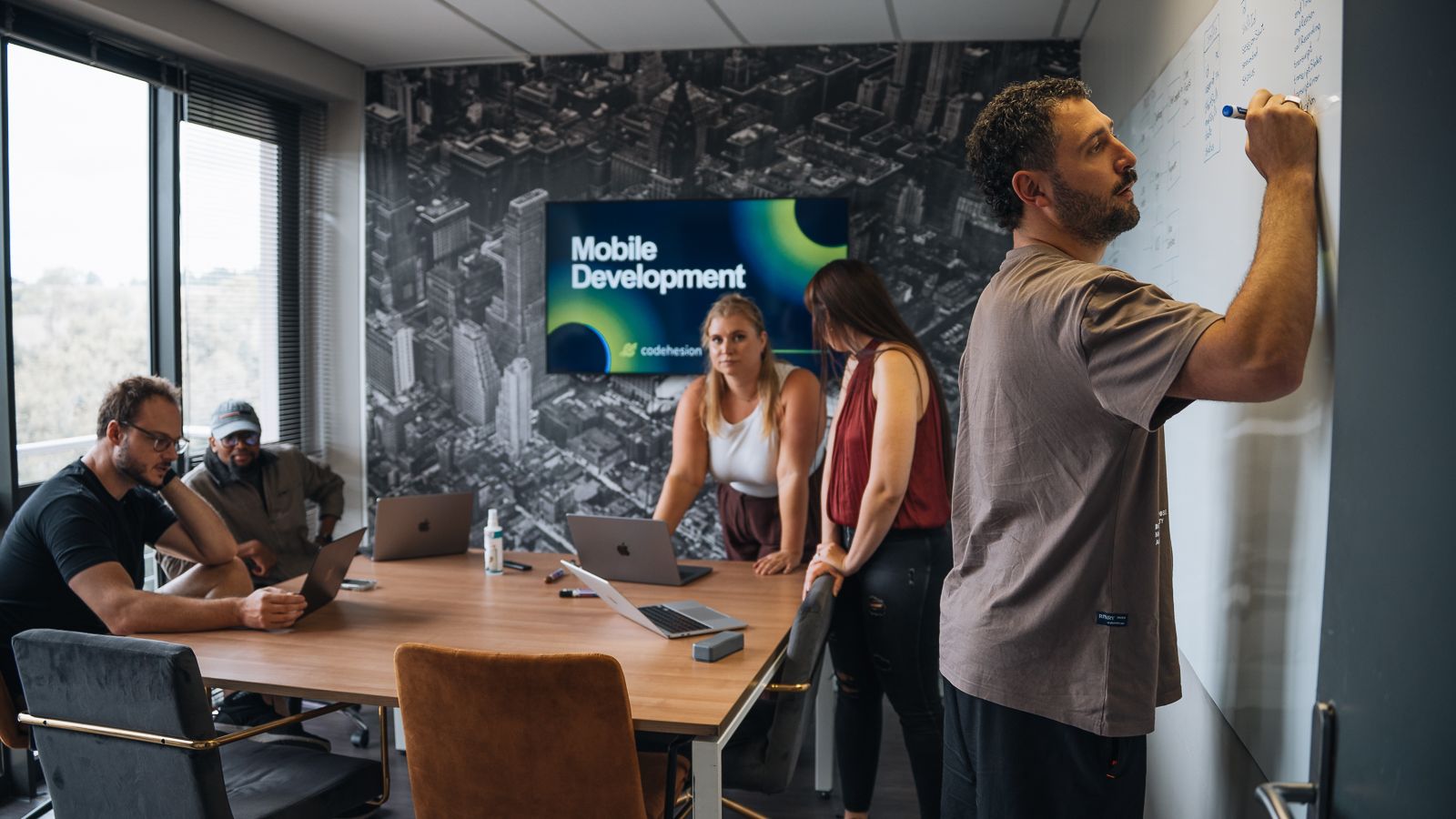
A Codehesion team mapping a process flow and app screens on the whiteboard
05

5. How we use AI

We're an AI-leading team: we stay at the front of what AI can do in software development, and keep it safe for production. AI takes the routine work at every step, from first drafts of requirements to tests and code reviews, so our specialists spend their time on design, architecture and the engineering that holds up in production. That's how we deliver 2–4× faster without cutting corners.

  1. 01

    People plan and make the decisions; AI speeds up the building once the plan is set.

  2. 02

    Nothing merges without a named engineer's approval.

  3. 03

    Your code and data are never used to train AI models, and we follow your company's AI policy if you have one.

06

6. Knowing where things stand

You deal with one project manager who knows your project inside out, and you never have to chase for an update.

  1. 01

    Daily stand-ups, so blockers are cleared fast.

  2. 02

    A written update every week: what's done, what's next, and anything waiting on you.

  3. 03

    A demo at the end of every sprint, and your sign-off.

We work in small phases, each with its own plan and estimate, so the estimates stay honest and you see progress all the way.

07

7. Changing the team

Your team changes as your product does: bigger for a build, smaller once it's live, and bigger again whenever there's something new to build.

  1. 01

    Scale up or down month to month. Change the hours as your work changes.

  2. 02

    When someone's on leave or moves on. Your context is shared across the team, in documentation and code reviews, so the knowledge stays with your project.

  3. 03

    After launch. The same people can look after it, with agreed response times.

  4. 04

    When there's something new to build. The same team ramps straight back up. They already know your product, your systems and your people, so nothing starts from zero.

Lesaka runs several pods side by side on one programme.

08

8. How we charge

You pay for a monthly block of hours, not for individual people, and the hours go wherever your project needs them that month. That's how a whole team costs the same as outsourcing a single developer. There's no lock-in.

First stepA paid, fixed-fee Discovery week or code audit, so you see how we work before you commit to a team
Monthly teamFrom 100 to 400+ hours a month, changed month to month with one month's notice
After launchA monthly support agreement, sized to how critical your systems are
What you don't pay forRecruitment, onboarding, tools, and the months it takes a new hire to get up to speed
Who owns itYou do: all code and IP, from day one

We'll give you clear numbers in the first conversation.

Every team we send comes with the analysis, design, architecture, testing and releases that the usual offer leaves out, so the only thing left to talk about is your product.

08Let’s talk

Questions this guide didn't answer?

Tell us how your team works today.